
Back to School: The Difference
Following a nail-biting but successful A-level results day in August, two young people from our Supported Lodgings scheme have headed to university to embark on their undergraduate studies. This includes a young person who suddenly, and tragically, lost her mum at the start of the year and, after a period living alone at home with her dog, moved in with hosts in April. Remarkably, she achieved the grades she needed to start a History and Philosophy degree and we had the privilege of accompanying her to university last weekend.
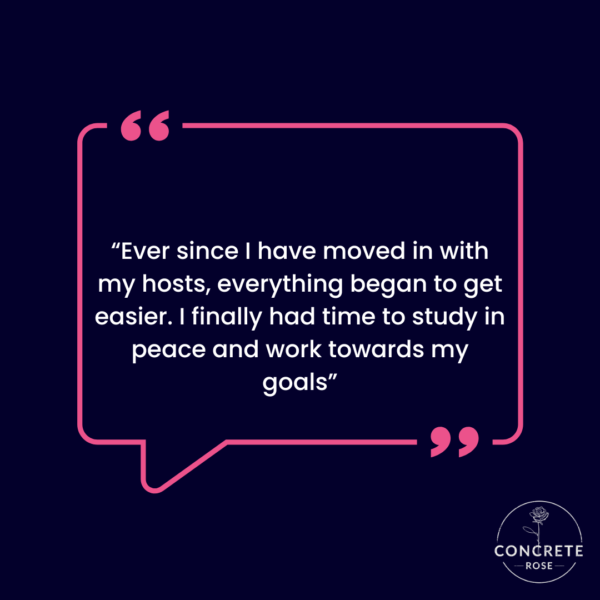
This will make it, in total, three young people who have progressed to university from living with hosts which undoubtedly ‘bucks the trend’. Unfortunately, reaching undergraduate study is unusual for those who have experienced time in, or on the edge of, the care system: only 13% of looked-after children progress on to higher education by age 19 (compared with 45% of their non care-experienced peers). This is despite the extremely positive, if not transformational, effects and opportunities that university can offer: studies suggest that going to university can “close the gap” for care experienced young people, with graduate employment rates more or less comparable with their peers, affording them “scope to transcend the manifest disadvantages of their early lives”.
But even for those who make it into higher education, thriving at university can be challenging without family support networks. Care leavers are twice as likely to drop out of university, are more likely to need to take a break from their studies, and their chances of gaining a 1st or 2.1 are 12.1% lower than for non care-experienced students. 68% of care leavers also experience mental health difficulties whilst at university, compared with 37% for non care-experienced students.
BBC broadcaster Ashley John-Baptiste recently described his experience of making it to Cambridge University from a bewildering background of four foster placements in his book “Looked After”, also available as an audio book.
Statistics like these are part of the rationale for establishing our mentoring scheme for care-experienced and/or estranged (from their families) students at Cambridge University, and also the reason that we will continue to provide significant wrap-around support to those who move on to university from our supported lodgings scheme. This includes a guarantee to provide a place for young people to ‘bounce back’ to during university holidays and after graduation.
This bounce-back or “boomerang” option is especially important post-graduation when support from universities (including housing) often falls away and students are left needing to sort jobs and housing, even during their final exams, in order to guard against homelessness. Important research into this ‘cliff edge’ has been undertaken by Dr Zoe Baker who has found that care-experienced students often “need to quickly accept a job to meet their basic living costs urgently after graduating, even if this doesn’t align with their degree qualification and desired career plans”. This is backed in up our own experience through our mentoring programme, which has fuelled our efforts to source short-term supported lodgings options (for three months) for care-experienced graduates.
As it stands, we are delighted to report that all of our young people are in some form of full-time education and/or work, demonstrating the difference a safe, stable home can make.
New Empty Nester?
If you’re in the position where you have a spare room – maybe recently vacated by a child who is going to university – could you consider hosting a young adult or care-experienced student, giving them the opportunity to beat the odds and build a firm foundation for the future? If you don’t have a room, then why not consider becoming a mentor for a care-experienced student via our mentoring programme: www.concretrose.co.uk/mentoring
Written on: 09/23/2024

Become a host
Interested in finding out more about hosting? Check out our ‘Information for hosts‘

