


Kiel Delaunois, Volunteer Employability and Careers Project Lead, shares insights from the work she’s started with Concrete Rose young people on individual pathways into the workplace. Kiel has a background in Early Careers development, formerly working at The Technology Partnership (TTP). Phase 1 of her work has been undertaking a “gap analysis” to understand what’s needed and what’s missing for at-risk young people on the pathway into work, so that Concrete Rose can provide relevant and appropriate support without reinventing any existing wheels.
Having recently joined Concrete Rose as a volunteer Employability and Careers Project Lead, I am excited to share news of my first contributions to this kind-hearted community.
During these past few months, I have had the opportunity to speak with several of the young care-leavers and estranged students on their journey through education to employment and it has been really rewarding to be able to offer them advice and to work towards a plan to support them further in the future.
My key take-aways from these conversations were that there is far too little emphasis on employment readiness within the education system. External support is often very patchy and often discovered through word of mouth, and the council’s personal assistants are over-stretched and often limited in what they can offer.
Cambridge students often feel quite confident in finding work after University, until they start applying and are then shocked by how hard it is. Whilst some Cambridge colleges offer great employment support programmes for disadvantaged students, most are still relying on the central careers service which has a limited offering and relies on students signing up and pushing for help.
Looking for work is a lonely activity, and without a support system around you, it can be difficult to keep positive. You can work extremely hard and see nothing come through, it’s often unsaid rules and the lack of a network that trip our young people up.
- Did you know? As many as 80% of jobs are filled through personal and professional connections (https://www.cnbc.com/2019/12/27/how-to-get-a-job-often-comes-down-to-one-elite-personal-asset.html)
I also researched the charity landscape of youth employability and the benefits this could provide for the young people Concrete Rose supports, and I have created a resource to collate their offerings to help point people in the right direction, identifying four under-served and key areas of focus for CR to support care leavers and estranged youth into employment:
1. Pre-employability Aspiration Building
This is particularly fundamental for young people who are not in education, employment or training (NEET), and so far, few organisations make this a key focus (Inspire to Ignite being one of the few). Young people need help to develop their personal values and identify their strengths – often through regular interactions with a trusted adult who notices what’s important and enjoyable to them. Due to the recent government emphasis on employer interactions in schools (the Gatsby Benchmark rules), there is some great work being done to help pre-employability and creating aspirations. But young people not in school or work don’t get access to this.
Care leavers in England, in particular, are over ten times more likely than their peers to be NEET and even fewer organisations focus on building the aspirations of this group – when, as this figure shows, this is the group that needs it most.
2. Age-limited support
We need to help young people regardless of their age. Few organisations support young people above the age of 25; the Young Women’s Trust is one of few that explicitly offer help up to age 30. Care leavers have had to focus on so many other things, like finding housing, their safety and mental health, before they can even consider employment. So, it makes sense that any organisation working with care-experienced and estranged young people should offer the same support regardless of whether they are 20 or 30.
3. Building networks
Both professional and support networks are key to success. Networking is often the key to finding a job, and research suggests 70-80% jobs are found through existing networks, so we need to support those without one. This is why we are planning to create a Trauma-Informed Employers Network, to help our young people with finding work experience and roles, contacts to speak to about sectors and on-the-job support.
4. Getting on: in-work mentoring
After they get into their first job, young people are often left to navigate that environment on their own. Support once in work, around how to dress, behave, deal with conflict, ask for a raise and get a promotion, are things no one focuses on. Parents are the quiet differentiator, telling their children how to get on – without that support care-leavers are left behind.
So in Concrete Rose, we’re reaching the young people touched by CR lodgings and mentoring through the Hub meet-ups, offering tailored CV advice, interview tips, identifying strengths and values, andproviding a weekly job application support meet-up, The Lemon Club.
I’m looking forward to working alongside our young people to support them in finding purpose and meaningful employment that plays to their strengths and values.
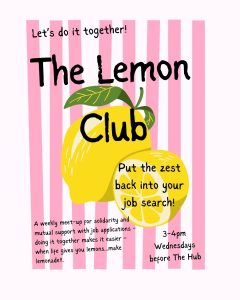 The Lemon Club
We’ve started a weekly get-together before The Hub for young people in the Concrete Rose community to gather for mutual social support whilst doing job, university and life application forms. Job hunting in particular can be a very isolating process, and many of our young people have expressed how disheartening it can be given the recruitment culture of not giving feedback.
The gathering goes under the name The Lemon Club as a reflection of our goals in launching this, to put the zest back into an otherwise boring and anxiety producing process, make lemonade out of something people generally find sour, and boost our collective immunity to knock backs.
Written on: 04/22/2026

Become a host
Interested in finding out more about hosting? Check out our ‘Information for hosts‘

