

Our western culture and Generation Z
Generation Z (– young people born between 1997 and 2012) are being observed with curiosity and concern. Sometimes coined ‘Generation Anxiety’, they seem to be manifesting mental health problems, neurodiversity and identity issues like no generation before. They are at times maligned for being ‘flaky’, ‘self-obsessed’, or ‘lazy’, and are often thought of as the first generation of digital natives, having grown up with the internet at their fingertips. But is this the whole picture?
Concrete Rose currently works exclusively with Gen Z. We have been reflecting on our experience of working with our young people and students and reading recent research in the fields of psychology and sociology, in an effort to get underneath the stereotypes, and understand this generation better. And – perhaps even more importantly – to reflect on what this understanding might mean for ourselves and our work.
So what do we really observe about Gen Z? What characterises them?
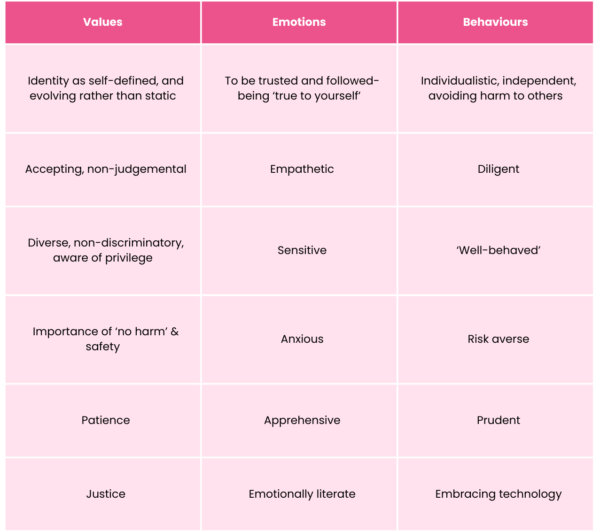
Contrary to the media image of a generation frightened of hard work, studies have shown that Gen Z tend to be diligent, prudent, pragmatic, and well behaved. Yes, they are keen – insistent perhaps – on achieving work/life balance: they have an expectation that there will be more to adult life than work – but through their school and university years they typically work hard, and have higher academic achievements than previous generations. They are patient – delaying fun till after A levels, delaying marriage, accepting a long path to home ownership, and expecting a less linear educational and career path.
They are also exceptionally emotionally literate, and give far more weight to their emotions than previous generations. They tend to be apprehensive – about reputation management, FOMO and their own mental health. But they are also passionate about justice and freeing the oppressed; they are aware of privilege, and not only accept, but actively celebrate, difference and diversity. And they embrace technology as a tool to learn about the world, to connect with others and expand their horizons. And despite the bad news their media channels funnel them, most Gen Z’s carry a nugget of hope that things will get better.
These elements are summarised in the table below:
Many of these characteristics mark significant sociological changes in a short period of time. Which must lead us to ask:
Why and how have these shifts come about?
Jonathan Haidt, in his book (controversially) titled ‘The Coddling of the American Mind’ explores this phenomenon with particular reference to American university campuses. And, given the influence of US culture on the UK’s Gen Z through the international media can hardly be overstated, his research resonates strongly here too.
His premise is that from the early 1980s to the 2010s, three powerful (bad) ideas took root in our collective cultural psyche, changing the way we parented, viewed and interacted with the world. And it is these deep changes which have shaped Gen Z.
Firstly, we began to believe that young people are fragile: they must be protected from harm, they must be kept safe, – not just physically safe, but ‘emotionally safe’ too. And so, as we parented, or led schools or institutions, we began to avoid risks, to prioritise safety, and to avoid situations which may bring conflict, discomfort or challenge. We began to do all we could to protect the next generation, as though we believed that ‘what doesn’t kill us makes us weaker’ rather than stronger. We tried, in every which way, to prepare the road for the child, rather than preparing the child for the road, and so we collectively stunted the personal growth and emotional resilience of a generation.
Secondly, we began to focus on feelings. As a counsellor, and one who is definitely more F(eeling) than T(hinking) (Myers Briggs) I do not see this as a wholly negative shift. There were certainly many parts of British nineteenth and twentieth century society that unhealthily ignored or denied the emotional realm, and did much harm through it. But as many pendulum swings do, this one has perhaps swung too far. Emotions began to be seen, not as a horse that one must learn to ride and direct, but rather as a trustworthy compass that points the way. Always trusting and following our feelings leads to hedonism and avoidance of delayed gratification, (though Gen Zs may be held back by anxiety and apprehension) and to a compounding of difficult emotions such as anxiety or sadness. Whilst Gen X perhaps began to acknowledge feelings more, Gen Z have fully embraced emotional reasoning, with particularly significant impacts on the spheres of mental health, self-worth and sexual behaviour.
Thirdly, we began to see the world as ‘us’ and ‘them’. “That’s not a new thing!” I hear you say, and we need to acknowledge that tribalism has been around for as long as humanity…. But in recent decades there has been a shift away from the Common Humanity Identity Politics (such as employed by Martin Luther King) and towards a Common Enemy Identity Politics. This approach demonises the views and behaviours of those outside the tribe, fails to assess the intention of others, and tends towards interpreting ‘their’ words and actions as offensively as possible. The algorithms of our media feeds exacerbate this trend, as does a school/ university call-out culture, in which students gain social credit for calling-out views, words or social media posts which could be interpreted to be ‘offensive’ to any intersectional group.
Outside educational institutions, most adults are sheltered from the extremes of this ‘us’ and ‘them’ mentality, but the impact on Gen Z is significant. Many will be afraid of speaking out their honest opinions, or exploring their own emerging views for fear of being ‘called-out’, attacked on social media and ousted from the tribe. And because there is little dialogue, other tribes are little understood – incomprehensible, even. They are assumed ‘wrong’ and not to be trusted. And that makes the world a scarier place to be in.
So what is our response to the cultural challenges Gen Z faces?
How should we, as Concrete Rose supported lodging hosts, mentors, or members of the community, help young people navigate the transition to adulthood in this sociological context? Here are some thoughts:
1) Let’s be compassionate towards their context, and the worldview and behaviours they may have adopted as a result. Afterall, baby boomers and Gen X have shaped the world they find themselves in. And let’s be real about the challenges they face.
2) Let’s gently challenge the bad ideas Gen Zs may have unconsciously swallowed. Can they begin to believe they are less fragile than they thought, that emotions can be acknowledged and directed, and that pursuing a common humanity, and believing the best of ‘them’, is possible, and even desirable?
3) Let’s encourage exploration, nuance, and thinking things through for themselves – whether climate change, identity politics or their own behaviours. Let’s help them to think critically about their engagement with the digital world – to make the most of the benefits of technology, and to minimise the potential adverse effects of high quantities of phone use. And let’s embolden them to take risks – to grow their own resilience, knowing we are backing them every step of the way.
Written by, Alison Taylor, Mentor Coordinator, Concrete Rose.
Written on: 11/19/2024

Become a host
Interested in finding out more about hosting? Check out our ‘Information for hosts‘

