

“All behaviour is a communication of need” – A therapeutic response to dysregulated behaviour
Having recently been in the process of reviewing the policies and procedures of Concrete Rose (sounds fun eh?) – including inviting collaboration from others in the team and our special advisors – I have been confronted with the need to adapt our “Challenging Behaviour Policy” to one that more accurately reflect the therapeutic and trauma-informed practices of the organisation. In our practice, including the training modules we deliver and our interactions with young people, we are well versed in the notion that ‘all behaviour is a communication of need’, that adolescents are far better motivated by reward than threats of consequence, and that love and safety are the transformative and unconditional elements of a healing environment. This does not negate the need for boundaries and consequences but recognises that these must be founded on, and borne out of, love, safety and understanding. In the words of Perry and Szalavitz:
“[M]any of the treatment programs and other interventions aimed at [children] get it backwards: they take a punitive approach and hope to lure children into good behaviour by restoring love and safety only when the children first start acting better. While such approaches may temporarily threaten children into doing what adults want they can’t provide the long-term, internal motivation that will ultimately help them control themselves better and become more loving towards others” (Perry and Szalavitz 2006: 244)”
With this in mind, this article explores how we should respond to dysregulated behaviour in a way that demonstrates love and care, maintains safety and helps young people develop their emotional intelligence and coping strategies.
1. See dysregulated behaviour as instructive
As already noted, all behaviour is a form of communication and, in the case of behaviour that may be seen as ‘difficult’, ‘disruptive’ or ‘challenging’, is usually communicating underlying feelings of pain and distress. In this sense behaviour is often automatic and involuntary and, when we understand that sometimes young people “cannot manage their own thoughts, feelings or behaviour” (Cairns, 2002) that is the beginning of seeing them in a new way. When we think of it in this way, behaviour can be thought of as, often, simply a way (however ‘illegitimate’) of getting across a legitimate feeling or need and often pain on the inside.
Secondly, dysregulated behaviour usually revolves around access to something or escape from something. For example, on the one hand a young person may be trying to access, an object, an activity or an experience. One example is that of a young woman in a residential care setting showing such dysregulated behaviour as to precipitate physical intervention due to a desire for physical touch.
On the other hand the young person may be looking to escape from a relatively lengthy task, a relatively difficult task, an unpleasant sensory experience. For example, getting out of a school lesson/activity that a young person finds challenging by becoming disruptive.
Although this is difficult ‘in the moment’ it is always worth reflecting on an episode of dysregulation for a young person and asking: ‘what was the underlying need being expressed?’ and ‘what was the young person trying to access or escape?’. This then allows the prospect of being able to proactively address the behaviour in another way before dysregulation occurs. In the example of the young woman in the care home (above) staff members recognised her desire for physical touch and responded by organising regular sessions of hair braiding to allow for the much-needed sensory experience without resorting to extreme behaviour.
2. Respond effectively at the point of dysregulation
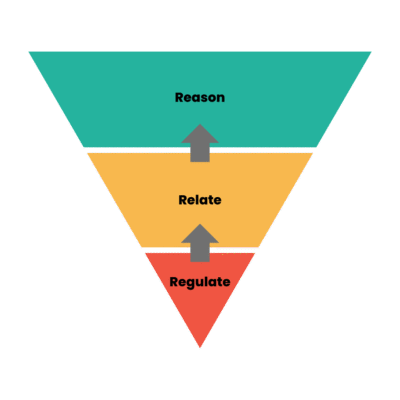
It is worth noting that this is not always easy to respond appropriately at the point a young person is dysregulated. We are all human and will make mistakes (especially if we are ourselves under a degree of stress). Nevertheless, it is often helpful to have a clear framework in mind that you can draw on to help you navigate the moment of dysregulation. We would strongly recommend, Bruce Perry’s neuro-sequential model which is outlined below and gives clear steps to follow when a young person is dysregulated:
Step 1: Regulate
The key first step is to help young people return to their ‘window of tolerance’ (Siegel, 1999) a place where they can think as well as act rather than simply reacting where cognitive processing is possible. It is essential that staff/hosts maintain their own composure at this point and recognise that “to calm a young person we must first calm ourselves” (Perry and Szalavitz 2006). Examples include:
- Stay calm: be aware of your own body language; use open gestures. Shouting across a room may further exacerbate things. Try to offer a calm but not patronising persona to aid regulation.
- Keep your own self control: get help, or walk away from a situation if you feel you are at risk of losing control. Certainly, don’t take anything a young person says in anger personally.
- Use names: call the young person by their name, and use “I” when referring to yourself.
- Encourage young people to regulate their emotions: Does the young person need to sit, walk, talk, to process their emotions. (If a young person sits down, sit with them to avoid being intimidating.)
- Stay with a distressed young person but sometimes at a distance: Don’t leave someone alone when they are upset unless you are sure they are safe. However, If a young person runs away try to keep an eye on where they are but you may need to accept that they need some space.
- Encourage young people to find a way out of difficult situations: make sure the individual can escape from a confrontation without losing face, and make sure there are gains in getting out of conflicts. Certainly, do not embarrass them in front of others.
- Remove the audience: where practical and possible, this can help diffuse a situation. Realise this could be you if you have become the focus of the other person’s escalating anger/fear/upset etc. By withdrawing you may give the person the opportunity to regain some control.
Step 2: Relate
This is only possible when young people are able to use cognitive processing (i.e. have returned to their window of tolerance) but it is important to re-establish safety and love before talking through consequences. The emphasis is on empathy and listening at this stage. Ways to do this include:
- Recognise their feelings: it might be unreasonable to kick or bite or scream, but it is not unreasonable to feel cross or unhappy. Help the individual to express their feelings. E.g. “I can see that you’re feeling upset, do you want to tell me why.”
- Make a distinction between a young person and their behaviour: make it clear that you will go on caring for the individual whatever they do, and recognise that their behaviour is not a personal affront to you.
- Try to understand their perspective: show that you are listening and try to reach partial agreement. Challenging behaviour is usually the symptom of a problem and not the problem itself.
- Acknowledge your mistakes/apologise if necessary: sometimes we will make mistakes or misread a situation. Don’t be afraid of apologising if this is the case.
Step 3: Reason
Reasoning with a young person (and applying consequences) is the last part of the process and judging the timing is key. Sometimes it may be appropriate immediately after the incident but usually there needs to be some distance between the incident and the time to talk it through. Any consequences that are issued must be consistent, fair and appropriate/understandable to the young person. It is also important to be able to move on and not hold past events against young people. Key points include:
- Judge the timing and where necessary postpone discussion about incidents: this allows tempers to subside, being clear that “we will discuss this when you are calm”.
- Use the opportunity for the young person to learn: try to help the young person come up with alternative (and positive) ways to deal with similar emotions in the future – i.e. “let’s do this” rather than “don’t do that”.
- Think carefully about punishments: it is known to be one of the least effective strategies for changing challenging behaviour. If you feel you have to use sanctions, make them immediate, fair, and proportionate.
- Be clear about your own expectations and feelings: young people need to be aware of what is expected of them but also clear about how it affects others. E.g. “Stealing not only shows a lack of respect for my property but damages our relationship as it makes it more difficult to trust you when I really want to.”
- Follow decisions through: Don’t issue consequences or threats you can’t or won’t carry out.
Summary
Understanding the underlying causes of dysregulation and having a key framework in order to respond is essential not only for the young person but also for you as the carer. As Whitwell (2010) said: “Love by itself is not enough. Many carers will intuitively do the right thing without knowing why. Unless carers receive training to help make sense of behaviours which are symptoms of the underlying emotional disturbance (panic rages, disruption, no guilt, splitting), they will burn out.”
Finally, as well as improving the content of our old behaviour policy we’ve also recognised the need to change its name. This may seem an unnecessary semantic exercise; surely the behaviour is at times challenging? Whilst this is true, language matters and can to some degree inform culture. A “challenging behaviour policy” immediately emphasises a top down, punitive, and anxious laden response that stigmatises young people. We are committed to being a compassionate organisation that recognises behaviour as simply the outward expression of inward emotions and to empower young people to find healing and manage emotions in a way that enables them to thrive in society. At the moment our new policy title is “Boundaries and Behaviour: Setting expectations and responding to dysregulation” but we’re open to ideas…
Written on: 07/18/2025

Become a host
Interested in finding out more about hosting? Check out our ‘Information for hosts‘

