

This article has been adapted from “IN JEST – MAKING THE UNTHINKABLE DIGESTIBLE” (PATRICK TOMLINSON, 2023)
The Jester has a long history spanning centuries, with references dating back to circa 25th century BC. Recognizable by their motley clothing and distinctive cap-n-bells, jesters appear throughout history, including ancient Egypt, China, and the Roman Empire – although court jesters from Medieval Europe are what most of us think of when these fools come to mind.
The Jester’s role has a universal quality of playfulness. They were witty fools, employed by monarchs for entertainment but also for important diplomatic communication, gaining favour with powerful guests and showcasing their wealth and status. But some jesters were able to use their role to influence the ruling monarch, subtly impacting decision making and outcomes.
One of the challenges in difficult situations in life and work is how to move forward when the situation seems difficult and even dire. I am reminded of a time in a senior team meeting when all the organization’s problems were being named. The mood of despondency became heavy and silent. Then one of the people in the meeting broke the silence and said, ‘There’s nothing so bad that it can’t get worse’. I am not sure what was meant but it made us laugh and lightened the mood. We were then able to think better about our challenges. Playfulness has an important role to play – particularly in very serious work.
Beatrice K. Otto’s (2001) classic book Fools are Everywhere gives an illuminating overview of the role of the Jester through history, and the subject got me thinking about seriousness and lightness in my work in the field of childhood trauma and recovery. As with many other fields, this work is serious and weighty, and a lot can hinge on the outcomes of communication at a deeply human level. Sensitivity and depth of understanding are critical, and yet there needs to be space for playfulness.
As the leadership consultant, family therapist and Rabbi, Edwin. H. Friedman (1999) argued, when things become deadly serious it can be more of a reflection on the state of the system than the issues at hand.
Playfulness as the litmus test in a system
Friedman claimed that deadly seriousness in a system, whether that be a family, organization, or society, is often a symptom of the system being gridlocked by chronic anxiety. This kind of seriousness is not creative or likely to help things move forward. He argues (1999), “A major criterion for judging the anxiety level of any society is the loss of its capacity to be playful”.
Broadening the perspective, the relationship between anxiety and seriousness is so predictable that the absence of playfulness in any institution is almost always a clue to the degree of its emotional regression.
Jester’s Privilege
The jester has had the role of a “licensed fool”, allowed to voice opinions and criticisms that would have been dangerous for others to express, without fear of reprise (although the jester in history would sometimes be disposed of if their jesting was too close to the bone).
In talking about leadership consultancy, Manfred Kets De Vries uses the term ‘insultant’. By this, he means that the role of being outside of the system allows observations to be made, truths to be told, and questions asked, which might not otherwise be tolerable within the system. Similarly, Anton Obholzer, in his book Workplace Intelligence: Unconscious Forces and How to Manage Them, argues that the role of a consultant enables a degree of ‘licensed stupidity’. Simply asking a question or lightly making an observation, whilst initially being met with defensiveness and disbelief, may unlock the system and enable assumptions to be challenged.
Speaking the Unspeakable
The Jester in a group may have a playful, mischievous quality of speaking with tongue in cheek, being able to speak truths or put forward suggestions in jest, sometimes opening up new ways of thinking. Historically, the Jester would sometimes be more influential and useful to the person in charge than those with high rank. Similarly, feedback from the ‘fool’ or jester may feel less threatening to one’s position, an easier pill to swallow.
Jester as a “get out of jail free” card
Playfulness can sometimes get you out of a rut more successfully than seriousness.
Being playful in the face of difficult problems is not easy. It is a delicate psychological task. It might seem counterintuitive, even though we know that creativity depends upon playfulness. One runs the risk of seeming insensitive or not taking matters seriously, which can feel like a catch-22 situation. Friedman (1994) refers to “The seriousness of tragedy and the tragedy of seriousness”. But deftly done, playfulness can neatly sidestep the head-on-ness of a very serious situation and open up new possibilities and outcomes.
Making truth safe
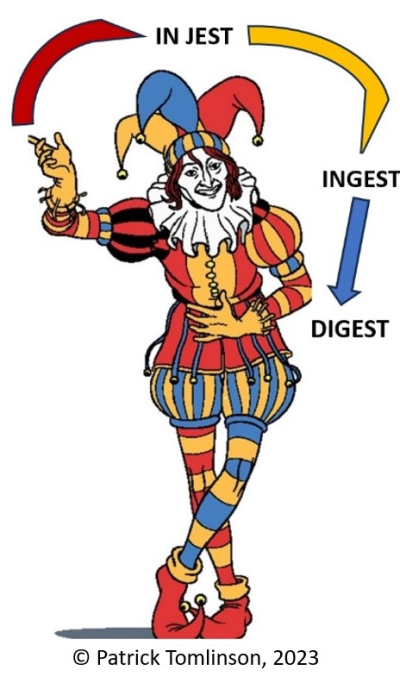
There is a parallel with the concept of emotional containment, described by the psychoanalyst Wilfred Bion (1977), of making the unthinkable thinkable. The phrase ‘in jest’, as in ‘many a true word spoken in jest’, has the same pronunciation as ingest. The use of humour, jest, and lightness may allow us to ingest, take something in and think about it. With anxiety contained, we are then more able to digest and make sense of what was previously overwhelming, unthinkable, and indigestible. Digesting and making sense of experience allows us to be, to ‘sit with’, to feel, and to use our imagination playfully. The lightness of a non-anxious presence can help facilitate this.
The neuroscience of playfulness and creativity
Gelotology is a growing scientific discipline that studies the psychological and physiological effects of humour and laughter on the brain and the immune system. Laughter has many cognitive benefits, activating both sides of the brain, increasing neural connections and improving cognitive function such as problem-solving, verbal and creative fluency, memory and emotional resilience, while also removing barriers to creativity such as stress and anxiety.
Neuropsychologist Rex Young contrasts creative capacities with intellectual capacities: reasoning, the ability to acquire and process facts and observations, is fundamentally different from the ability to put them together in innovative ways. Intellectual tasks cause neural networks to function in more directed and linear ways, while creative tasks show more meandering and circumlocutory neural pathways.
Laughing swaps the cortisol in our bloodstream with highly sought after brain chemicals dopamine, oxytocin and endorphins. Dopamine can enhance learning, motivation, and attention; oxytocin is known as the “empathy hormone” and the “bonding chemical,” and endorphins trigger feelings of pleasure.
When we laugh, our brain lights up in multiple areas, including:
• The prefrontal cortex, responsible for decision-making and social behaviour
• The amygdala, linked to emotion processing
• The hippocampus, which plays a role in memory formation
• The nucleus accumbens, involved in reward and pleasure
These regions work together to process the cognitive, emotional, and physical aspects of humour, recognising incongruity, resolving the punchline, and triggering laughter.
Laughter is also highly social, and positive interactions are vital for brain health. Sharing a laugh with others increases empathy and can even protect against age-related cognitive decline.
Never underestimate the power of the Jester to shine new light on a situation and lead a group safely through challenges.
References
Bion, W.R. (1977) Second Thoughts, New York: Jason Aronson
Friedman, E.H. (1994) An Interview with the First Family Counselor, in, The Myth of the Shiksa and Other Essays (2008), Church Publishing: New York
Friedman, E.H. (1999) A Failure of Nerve: Leadership in the Age of the Quick Fix, Church Publishing: New York
Kets de Vries, M.F.R. (2022) A Merchant of Hope – An Interview with Professor Manfred F.R. Kets de Vries, The Inner Edge with Shane Cradock, https://open.spotify.com/episode/7wtQCahqKtAY8FGTzVCG9J
Obholzer, A. (2021) Workplace Intelligence: Unconscious Forces and How to Manage Them, London and New York: Routledge
Otto, B.K. (2001) Fools are Everywhere: The Court Jester Around the World, Chicago: Chicago University Press
Ma, M. (2014), The Power of Humor in Ideation and Creativity 2014, Psychology Today
https://www.psychologytoday.com/gb/blog/the-tao-of-innovation/201406/the-power-of-humor-in-ideation-and-creativity
https://www.psychologytoday.com/gb/blog/the-tao-of-innovation/201406/the-power-of-humor-in-ideation-and-creativity
Written on: 09/26/2025

Become a host
Interested in finding out more about hosting? Check out our ‘Information for hosts‘

