O horror! Horror! Horror! Tongue nor heart
cannot conceive nor name thee!
Macbeth, Shakespeare
Development Officer Rachel Osborne explores the physiological implications of trauma with reference to The Body Keeps the Score, considering how this seminal research can inform our practise whilst working with survivors.
Artists, writers and philosophers have long sought adequate form to express the horror of trauma. And yet, as psychiatrist and trauma-researcher, Dr Bessel Van der Kolk writes in his seminal text, The Body Keeps the Score, ‘even years later, traumatised people have enormous difficulty telling other people what has happened to them’. Words simply fail. Formerly, this inability of trauma-survivors to speak the unspeakable was understood to be informed by emotion; the memories were just too painful to express and so victims selected silence. But developments in neuroscience over the past 40 years have revealed trauma’s imprint to be far more insidious – and sophisticated – than this; the research of experts such as Dr Van Der Kolk, alongside developments in functional brain imaging, have enlightened us to the acute impact trauma can have on our very physiology, and the profound ways it alters our biology and immune systems.
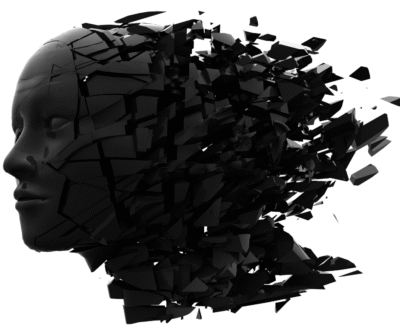
We now understand, for instance, that alexithymia – the inability to describe one’s thoughts and feelings – is not always caused by emotional overwhelm, but can be caused by shut down of the Broca area of the brain, the language centre. This is because the Broca area is located in the neocortex, the executive functioning area of the brain which is ‘vulnerable to going offline’ in response to threat.
When the ‘alarm system’ of the brain activates, it automatically triggers operational pare back, shutting down the executive functioning areas of the brain and focussing on areas that promote survival. Most of us are familiar with the subsequent manifestations of the ‘fight’, flight’, ‘freeze’ response, either because we have suffered the discomfort of experiencing them ourselves or witnessed them in others. The ‘collapse’ response (resulting in extreme immobilisation such as fainting, losing consciousness or disassociation) reflects, as Van der Kolk would see it, a more primeval response. Such disconnection indicates a chronically traumatised mind; awareness is so shut down that individuals may no longer even register physical pain.
The implications of trauma for victim physiology are grave and seemingly endless. As Van Der Kolk explores in his case studies, victims suffer complex physical pain disorders that have no identifiable cause; they are more frequently ill and they die at a younger age than their non-traumatised counterparts. What seems particularly cruel about post-traumatic stress disorder is that its symptoms and behaviours can become repetitive, experienced in bouts, or, worse still, the traumatised state can become the modus operandi. Traumatic experience interferes with the brain’s ability to interpret safety and thus relax. Though complex autonomic responses are designed to ensure our survival, when faulty signalling occurs, trauma victims remain imprisoned within their own psyches, unable to move forward. As such, they are ‘frozen, trapped in a place they desperately wish to escape… chronically unsafe inside their own bodies’. Is it any wonder that those beholden to such disabling and frightening sensations self-medicate through drugs and alcohol? Or that they feel condemned to a torturous existence and perceive themselves as ‘damaged to the core and beyond redemption’? Our increasing understanding of trauma’s impact enables to look compassionately upon those suffering, and to dismiss the idea that their erratic behaviour or addictions are simply due to moral failing or character flaw.
It is vital we solemnly acknowledge the pervasive nature of post-traumatic stress disorder and its severity so that we might commensurately celebrate that recovery is utterly plausible. Perhaps the most mesmerising and compelling case studies in Dr Van der Kolk’s book centre not just on the damage that trauma inflicts upon victims – but on the emboldened hope we can have for their integrated healing – and indeed their post-traumatic growth. But how do we, as practitioners, professionals and just decent people who care, facilitate this flourishing to take place?
Logically and perhaps unsurprisingly, most of Dr Van der Kolk’s research outcomes indicate that it is the antithesis of the trauma experience that affords victims the capacity to heal. At the time of his writing, Van der Kolk refers to the American Diagnostic and Statistical Manual of Mental Disorders (DSM) to define traumatic experience as ‘a horrendous event that involved actual or threatened death or serious injury, or a threat to physical integrity of self or others, ‘causing intense fear, helplessness or horror’. Healing, then, lies in the following provisions: –
Physical Safety and Engagement
“The boundary lines have fallen for me in pleasant places; surely I have a delightful inheritance” PSALM 16:6
- To soothe the nervous system, victims must feel profoundly safe physically, ‘allowing the body to have experiences that deeply and viscerally contradict the helplessness, rage or collapse that result(ed) from trauma’.
- Touch, exercise and rhythmic movement are also identified by Dr Van der Kolk to be vital in recalibrating a traumatised brain and body, reengaging the senses and allowing for formerly ‘suppressed powerful physical impulses’ to find their expression.
Relational Safety and Engagement
‘There is no fear in love, but perfect love drives out fear’ 1 John 14: 18
- Survivors of trauma need loyal friendships and love. Dr Van der Kolk states that ‘being truly heard and seen by the people around us, feeling that we are held in someone’s mind and heart’ is what enables our physiology to calm down, heal and grow. Indeed, countless studies have proven the significance of good social networks, highlighting them as ‘the single most powerful protection against becoming traumatised’
- Connecting with others through light-hearted fun might seem futile or even crass in the light of severe trauma but, conversely, playfulness is paramount to recovery. It allows the limbic system to regulate and the neocortex to engage fully with its surroundings.
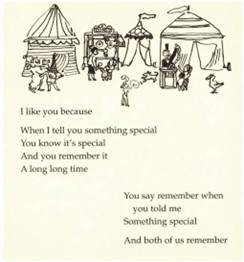
Image taken from the book “I like you” by Sandol Stoddard
Safety with Self
“I came that they might have life and have it to the full” John 10:10
Ultimately, Van Der Kolk writes, ‘the challenge of recovery is to re-establish ownership of one’s own body and mind – of self’:
- Story-telling, writing and artistic creation may at first feel stunted, fragmented by the inexpressible nature of trauma, but Van der Kolk notes that the imagination is a powerful tool for recovery once victims are in less extreme states of traumatisation. Imagination, he states, enables survivors to ‘circumvent the speechlessness that comes with terror’, to tell their stories and to own their narratives. He also observes that ‘it is through fantasising about travel, food, sex (and) falling in love’ that we ‘leave our daily routine’; trauma survivors can engage their imaginations to escape the confines of their painful experiences, helping them conjure a new future of freedom and healing.
- Outward expression, either verbal or written also offers us the opportunity to ‘survey our internal landscape with compassion and curiosity’. As our stories become external to us, we are no longer dumbfounded and internally besieged, but autonomous authors, able to self-direct our lives.
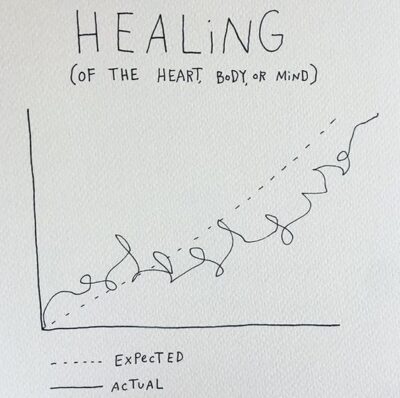
This brief overview of the key interventions which alleviate trauma response and ultimately offer deep-rooted healing is not exhaustive, nor are these interventions easy and quantifiable deliverables with measurable progress markers. After all, it is love, above everything else, that casts out fear and heals us, holding us dear whilst propelling us forward. Particularly hopeful for those of working with young people is Van der Kolk’s confidence that ‘our inner maps can be modified by experience. A deep love relationship, particularly during adolescence, when the brain once again goes through a period of exponential change, truly can transform us’.
https://www.instagram.com/bymariandrew/
And what then? Once the war for holistic wellbeing has been hard-won? Then comes the capacity and courage for miracles. Van der Kolk reminds us that those who have been through extreme trauma can become remarkable: ‘Read the life story of any great visionary and you will find insight and passions that come from having dealt with devastation.’ What a privilege to play a small part in the redemptive story of these young people.
Give me a place on which to stand,
and I will move the earth.
Archimedes
Written on: 05/23/2025

Become a host
Interested in finding out more about hosting? Check out our ‘Information for hosts‘

