

Building on our the last blog post “Embracing Failure”, this article focusses on the importance of creating psychological safety, particularly to help fuel thriving organisational practice and performance.
Overview
Psychological safety is the belief, in a group, that we are safe to take interpersonal risks. It’s the belief that we are able to speak up with ideas, questions, concerns and mistakes, and that we won’t suffer negative social or professional consequences as a result.
The concept was popularised by Amy Edmondson, a professor at Harvard Business School. Her research in the 1990s found that teams that made more mistakes actually performed better — not because they made more mistakes, but because they were more open about them and could learn from them.

Google’s “Project Aristotle” also found psychological safety to be the most important factor in building high-performing teams. Unlike trust, which arises between two individuals, psychological safety is a property of a group, where people within that group can confidently predict how others will react when presented with ideas, questions, concerns or mistakes.
What does psychological safety look and feel like?
The 4 key pillars of a psychologically safe environment are:
- Inclusion Safety supporting interpersonal risk-taking: people feel comfortable being themselves and belonging to a team — expressing concerns, offering feedback, or challenging the status quo.
- Learner Safety with no fear of blame or retaliation: mistakes are seen as learning opportunities, not failures to be punished.
- Contributor Safety: everyone’s voice is valued, regardless of rank or background. Team members listen to each other respectfully.
- Challenger Safety: open communication where honest dialogue is encouraged, even when the topic is difficult or controversial. People are able to question others’ ideas or suggest significant changes to ideas, plans, or ways of working.
With psychologically safe environments providing the most fertile ground for learning, and thus performance, Amy Edmondson links psychological safety directly with accountability and motivation, proposing four functional quadrants, with learning as the ultimate goal for high performance:
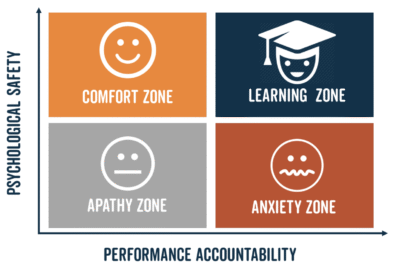
- High accountability/motivation and low psychological safety leaves people stressed out in the Anxiety Zone.
- Low accountability/motivation and low psychological safety places people in the Apathy Zone.
- Low accountability/motivation and high psychological safety means people are coasting along in the Comfort Zone.
- High accountability/motivation and high psychological safety creates the Learning Zone: the best place to be for peak performance and practice.
The benefits of psychological safety
To feel safe is a basic human need and part of our genetic make-up, the second rung of Maslow’s Hierarchy of Needs after basic food and shelter. Psychological safety is absolutely fundamental for learning, innovation and “great work”. Nobody is going to do their best work in an environment where they’re expending cognitive energy on “measuring up”, competing and watching their back, their brain flooded with cortisol in constant “fight or flight” mode.
But psychological safety is in scarce supply in a competitive world where winning comes at a cost to others. In psychologically unsafe groups, members may feel they have to put on a metaphorical “mask”, and be a different version of themselves in order to fit in. They may not feel able to admit mistakes, or ask for help, in case members of the team see it as a weakness and use it against them.
There are many benefits of psychological safety, including:
- Better Performance: teams with high psychological safety tend to perform better because members can collaborate and innovate more freely.
- Fewer mistakes and incidents
- Smaller impact of mistakes and incidents
- More ideas
- More freedom to explore and improve ideas
- Faster delivery and time-to-market
- Fewer security, safety and non-compliance issues
- Improved reputation
- Higher Engagement: employees feel more motivated and connected to their work.
- Reduction in burnout
- Increased inclusion and diversity
- Lower employee turnover
- Improved ability to attract and recruit the best people
- Greater resilience of people and teams
- Greater Learning & Improvement: mistakes are discussed and learned from rather than hidden or ignored
- Improved ability for individuals to learn from mistakes
- Greater sharing of learning across group members
- Improved ability to carry out experiments and risk “intelligent failures”
How to embed this into your organisational practice
Below are some broad themes as to how you may look to improve and embed psychological safety in the organisation you are a part of. We’ve also given some practical examples of how we try to do this at Concrete Rose. Whilst we recognise we can always improve in this area – and we certainly don’t get it right all the time – it is absolutely at the core of what we do (and permeates the entirety of the organisation) and essential to enable young people, hosts, staff and volunteers to thrive.
- Model vulnerability: leaders admitting they don’t have all the answers can set the tone. At Concrete Rose, team meetings are opportunities to feed back on failures and low-points as well as successes and high points. This is not about shared empathy but shared honesty and improved practice. Staff members also commit themselves to their own personal development (reading, training etc), recognising there is much to learn, and we regularly visit other organisations to learn from best-practice. In our support for young people and hosts, we also recognise the importance of collaboration with others, and particularly those with specialist knowledge in fields outside of our comfort zone.
- Encourage participation: ask for input from everyone, not just the loudest voices. Regular feedback, participation and collaboration from team members, volunteers, hosts and, most importantly, young people is key to our work. All our supervision meetings with staff have a standing agenda item of “dissension” to encourage constructive criticism and young people are part of spending decisions, interview processes and, of course, their own tailored support packages.
- Respond supportively: responding to criticism, however well meaning, is, truthfully, often a challenge especially when you take pride in your work. Nevertheless, embedding a sense that criticism is simply an opportunity to improve helps change the perspective. For example, although we are always reflective with hosts during a supported lodgings arrangement, when a young person moves on we take a considerable time to reflect on journey and especially how we as an organisation can learn from the challenging times and improve the support on offer. This information is then shared with the whole team and new practices put in place.
- Celebrate curiosity: reward experimentation and learning, even if things don’t always work out. One of our organisation values is that “we are ambitious”. When we drill down, what this means for staff is that we talk about “being prepared to step outside of your comfort zone to take on new initiatives”, to “challenge the status quo” and to “be prepared to try and fail”. The intention is to remain innovative, continually responding to the needs of young people and create a dynamic and evolving organisation.
For more resources on creating psychological safety in teams and organisations, see www.psychsafety.com.
Photo by Launde Morel on Unsplash
Written on: 04/25/2025

Become a host
Interested in finding out more about hosting? Check out our ‘Information for hosts‘

